Let your horse be right

smile like you mean it

Yesterday when I went out to train Aesop I had a clear idea in my head about what I wanted the training session to look like. I was going to practice his increasingly solid “riding from the ground” skills outside, in his saddle, and then play with a bit of balance work in trot as a reward for good RFTG. He really loves to trot now that he knows he gets “paid” for it in treats and wants to offer it any time the chance arises.

When we got outside and into the training session, it was clear Aesop needed a different lesson than the one I had planned. I had planned on doing a training session where we would review what he had already learned and get in some nice repetitions of fairly stable behaviors. But his behaviors weren’t where I had left them. He had processed the go forward with someone at your side really well from our last lesson and was ready to offer it just when asked to bend or when I got near the side of the saddle. He was ready to show me what a good walk-off looks like and I had been so busy envisioning our fun trot work I was caught totally off-guard. Here’s a video of me caught by surprise and re-setting his walk off’s, which I had worked so hard for the last three training sessions:

To be clear, Aesop isn’t too conflicted about being re-set. He handles the information in stride and doesn’t get emotional or frustrated. It is an ok training choice that centers around getting stimulus control.But many other young horses would be frustrated or discouraged to be interrupted at this stage in their learning. To my small credit, I am clicking and treating these re-sets because I am at least aware they are new to him. But in my work, I am looking to let the horse be right. It’s not a natural way to look at things, and it takes practice. So how can I let him be right? I can let him walk off and click for either soft bend within the walk off or staying with me, both of which are criteria I will have in this exercise. That allows Aesop to have the right answer while I am still building skills we need for our future riding. Here’s a video of me with my changed criteria:

In this video you can see that Aesop leans down on his forehand and walks off when I ask him to bend. He’s not waiting for my breath cue against his side and he’s walking through my bend request. But instead of re-setting and blocking him, I just go with him, but I wait for him to raise his head a bit and bend more correctly before I release the rein and click/reward. He gets to be right and I get behavior that I want, too. I can go back in in a few sessions, once he’s really confident about walking off and work on stimulus control. It’s not important right now.

Aesop and IPart of what I love so much about training is the number of choices it presents at every moment. It’s both what is hard about training and what makes the training session such an infinite place to inhabit. It’s what confounds newer trainers and obsesses those who make it a life’s work. There are training mantras, though, that can help a trainer navigate their choices better. In this case, the mantra was: Let you horse be right.

How to watch a training session

Female animal trainer and leopard.

When people watch an animal trainer work it is normal for them to focus on the end result rather than the training process. We’re not taught animal training in school except on a very abstract level, maybe in psychology class, so most humans can watch an entire training session without understanding what they are really seeing. We get so caught up in the transformation from untouched to under saddle in the horse, or the calm of the trainer in the face of flying hooves that we don’t notice what the trainer is doing to get behavior change. We’re often impressed with a trainer’s bravery in the face of possible physical harm – so impressed that we value the trainer just for the spectacle and drama of their work. But when we identify just with the human component of the equation or the spectacle, we can forget to check in and see if the animal is happy and relaxed. We can forget the animal has valid feelings too and didn’t choose to be trained. The way a trainer achieves behavior change matters, especially if we put ourselves in the animal’s place. We now know animals experience emotion much the same as humans do. We are wholly responsible for the emotions we elicit in our horses through training. To me, a trainer’s oath  should be the same as a physician: First, do no harm: physically or emotionally.

There’s been a video circulating lately of some Argentinian trainers working with  unhandled horses. They’re using an unusual technique that we don’t see here in America and it’s causing all sorts of speculation about what might be going on between trainer and animal. If you look up the man, his son and the method online you can find a description of it here. To sum up:  The method is a unique approach to tame horses in the most natural manner with avoiding punishment and cruelty on these beautiful animals. It focuses on gaining the horse’s trust and loyalty. The basics of the training are to learn about the horse’s nature, behavior and psychology; the goal is to persuade the horse to do something in order for it to learn. In this type of breeding it’s not necessary to be strong, or have special skills; it is all about knowledge and patience. It sounds like a wonderful way to teach a horse, noble, even. Below is a video clip of the method in action. I want you to watch it and imagine you are a 1-2 year old horse learning about humans for the first time in your life: 

How would you feel? Would you feel like the humans in this video were trying to actively gain your trust? Your loyalty? Do you think this looks like a method that avoids punishment? Can fear or confusion be just as punishing as pain?

Here’s another video. Again, imagine yourself as the young horse involved in this training. I would recommend listening without sound as it’s hard for humans not to be influenced by verbal “explanations” of training even when they don’t match the reality presented observationally:

How would you feel as this young horse? Would this feel like a positive experience to you? Does the pen seem to offer freedom or restriction? How would you feel having a rope continually tossed at you? How would you feel being allowed to run off but made to run farther and faster for your caution as a flight animal?

One last video to review:

How would you feel as this young horse? Does he look trusting already? Does he look ready to be ridden? How stressed does he look once his owner/trainer gets on his back? Does this look like a positive experience?

If I had one gift I could give  horse owners, it would be to learn to watch training sessions with a good critical eye. If a trainer uses a method you aren’t familiar with, observe what they are doing to the animal and imagine how it would make you feel in their place. If that is hard for you, ask a friend to “train” you the same way you observed. That will clarify VERY fast how you feel about the method. It sounds funny but you’ll be amazed at the different emotions you feel as long as you take it seriously.

You don’t have to be an experienced trainer to know if certain training methods utilize discomfort, fear or threat to achieve results.  If we suspend our human-ness for a moment and imagine ourselves as the animals in these videos it’s easy to make decisions about how we would like to be treated. All animals, humans included, enjoy choice, rewards and low stress learning environments. The emotions an animal feels while being trained aren’t just fleeting things that disappear like smoke once the training session is over. They get attached to certain predictors like the sight of the trainer, the equipment used or the space used for training. This is Pavlovian conditioning and it happens whether we want it to or not. While you train your horse in what to do you are also training your horse how to feel. So learn to watch a training session not just for the results but for the emotion it brings up in the horse.

The Golden Bridle

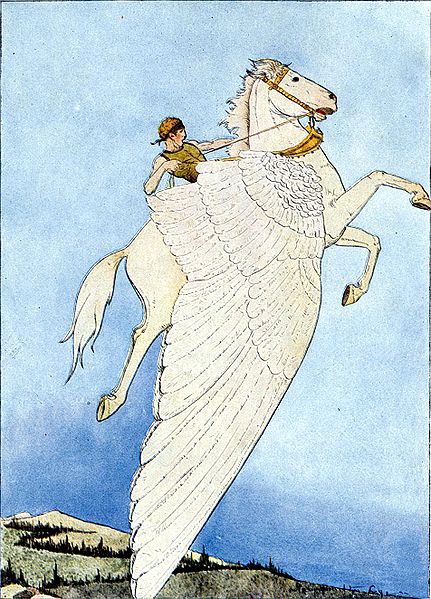
Pegasus in the golden bridleIn Greek mythology the magical winged horse, Pegasus, can only be tamed with a golden bridle. Bellerophon needs Pegasus to slay the Chimera and he spends months trying to catch him but he is unsuccessful. Finally he prays to the gods for help and he is instructed to sleep in the Temple of Athena. While he sleeps he dreams Athena visits him and tells him how to find Pegasus at the well where he drinks and gives him golden bridle that will allow him to ride Pegasus. When Bellerophon wakes up there is a golden bridle by his side and he knows the dream was real. He finds the well Athena described and captures Pegasus when he kneels down to drink by pushing the bridle over his head. Once the bridle is on Pegasus is beholden to Bellerophon’s will.

I like this myth because I think it plainly describes how much stock humans put in equipment. If we just have the right bridle, the right bit, the right caveson then our horse will be beholden to our will and our training issues will be solved. But the truth is equipment is only as good as the training that accompanies it. A bridle is a powerful tool, but horses learn how to respond to a bridle. You have to teach them. Golden bridles aren’t gifted by the gods, they are built by good training.

Since I will be riding Aesop in the spring again, I want to teach him how to work in a french riding caveson. This is work that can and should be taught from the ground. Here’s a video of Aesop’s first lesson learning how to be “ridden from the ground.”:

In the video you see Sara working with three different cues. Can you stand still while I lift my rein and wait for more information? Click/Reward. When I slide down the rein can you soften to me? Click/Reward. When I breathe in so my rib cage touches your side like my leg will once I am mounted can you walk off? Click/Reward.

It’s important to teach your horse rein cues before you get on so that you have a reliable language at your disposal. Horses have a blind spot directly behind them so they can’t see us once we are on their backs. We literally disappear from view. For many horses, that means they lose all of the visual training language they have built with their human once riding begins. Stressful, to say the least! I don’t want Aesop to be struggling to understand me once I am on his back. I want him to be confident about what is being asked of him and enjoying our training time. So I’m taking the time to teach him rein and tactile cues from the ground. Here’s our second session in the arena:

We are doing the same exercise you see in the first video. Can you stand still while I lift the reins? Click/Reward. Can you soften to me when I slide down the rein? Click/Reward. Can you walk off when you feel pressure on your side? Click/Reward. He’s overbending a bit when I slide down the rein but that is something that I can progressively shape to be smaller and smaller. He’s trying and that’s good. He is a bit confused about pressure on his side being a cue to walk off, especially because I have always walked off up by his head. I’m asking him to move off first AND from a new cue. That’s hard. But the video shows his best and lightest attempt. For his second session he’s doing a wonderful job.

Even if there was a magic golden bridle I could get by worshipping the right gods, I wouldn’t be interested. When Bellerophon removes the golden bridle, Pegasus flies away and Bellerophon spends the rest of his days searching for the horse. To me it’s a cautionary tale: Don’t let your equipment take the place of good communication with your horse. Take the time to teach your horse what he needs to know so you are bound by relationship and a common language.

Djinn’s hoof handling

snowflakeIt’s been a cold and snowy winter so I’ve been locked in the house doing far less horse training than I wish. Today alone the temperature might not climb above 0. I have to content myself with short sessions when it’s warm enough to train without freezing but I’m dreaming of green, long grass and daylight that stretches well into the evening hours. When it’s been warm enough I’ve continued to work on hoof handling with Djinn so we can get that skill set mastered this winter. Then, in spring we can move on to more exciting things like introducing her to the arena, walks on property and starting balance work.

Djinn isn’t a horse who has ever worried about her body being touched, which is a nice change of pace for me from my other mustangs. She has yet to be reactive to any touch, grooming or space. She likes touch and she feels generally safe around people. She came to me this way, likely because she was captured as a yearling, and spent so much time in close proximity to humans who fed her vast quantities of alfalfa and carrots. In fact, she was so trusting that she might push you right over on her way to do something else. So, we’ve done a lot of work around moving forward and back on the lead, keeping her head to herself and how to stand quietly. She has done beautifully with that work and it was time to move on to hoof care.

Most humans don’t properly understand how vulnerable a horse is when they offer their foot to you. As a prey animal flight is their safety. A held foot is a trap on a very basic level. As humans who think conceptually and big picture we instinctively scoff at this idea. We know that we are only picking up our horses feet to clean them out or teach them how to be relaxed for a trim. But how many of you have seen a horse with a leg trapped in a fence thrash and fight like their life depended on it? Relaxed foot handling is learned. It’s not natural but it can be taught fairly easily. The video below shows Djinn’s third session with her feet being held:

I had already taught Djinn to pick up her foot off a soft touch of the whip on her leg and to hold it up in the air with duration on her own. She could do this on a verbal cue “foot” so I felt confident changing to my hand cupping her foot instead of my whip against her fetlock. She didn’t seem too nervous about me holding her foot, but she did take her face off to the outside, which is a low level sign of discomfort. I hold the foot quietly, make sure I’m not adding tension to the situation by making sure I have a loose lead rope and I click her AND release her foot when she brings her face back to the center of her chest. There are two rewards here: the food – which is a bonus reward –  and giving her back her foot- which is a  functional reward. A good trainer is always aware of both. After several good repetitions I let her walk off and move her feet. Standing still is hard, especially for a young horse so I don’t want to take advantage of  her good behavior by asking for too many repetitions.
I stop her in the same place to work on her right side. She is less confident on her right and needs a gentle tactile cue of my sliding my hand down her leg to give her the idea of lifting her hoof. Since just getting her to lift the hoof was more difficult, I’m not going to be greedy and hold onto it too. Once her lift on the right is as immediate and easy as her lift on the left, I’ll raise my criteria and hold onto the hoof.

Djinn is a far cry from the emotional, barging, biting mare she was when she first arrived here from the BLM last summer. She came here unafraid of people but also unable to receive information from people. She didn’t know how to be directed. She was always frustrated and impatient and pushing for what she wanted. She has relaxed and become quite calm now that she understands how to look to her human training partner for cues. She’s starting to seem much more like the grown-up 4 year old she soon will be than the immature 3 year old she was when she arrived here.