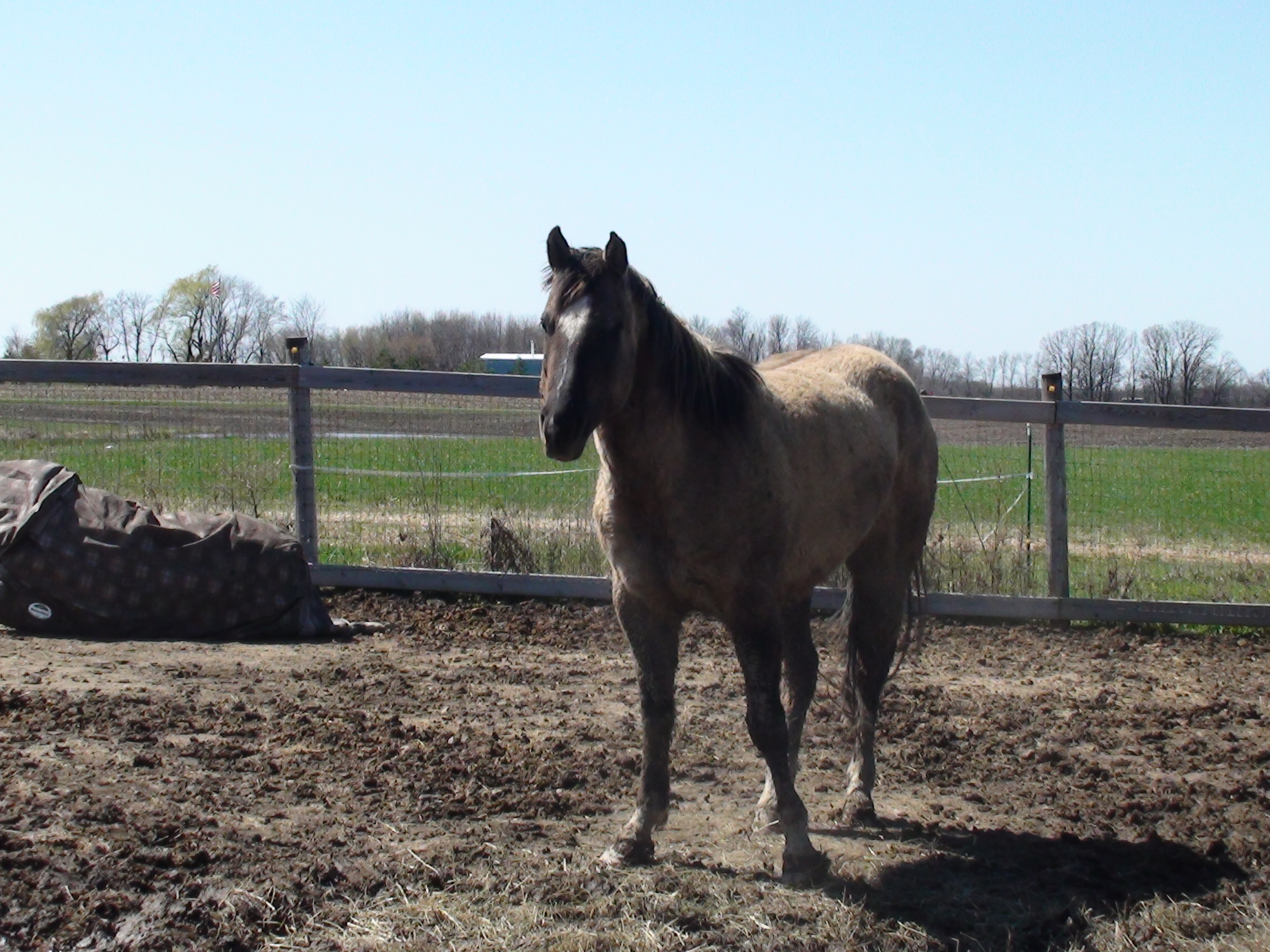
Conversations under saddle

Dragon and I have been working on the ridden WWYLM game for the past three weeks, and the exercise has really opened up our “discussion” while riding as well as pointing out to me the flaws in my riding. The exercise is simple enough: ride your horse forward on the buckle while steering him only with your weight and your core. If  he deviates from the frame/guide provided from your body, pick up the rein with your buckle hand, slide your rein hand down the rein so it is taut between the two hands and anchor your hand to the saddle. When your horse offers a smooth turn, picking up your seatbones, click/reward and release.

Before this exercise, let’s just say Dragon wasn’t the most intuitive or sensitive horse when it came to my core/weight. But to be fair, I  de-sensitized him A LOT by not being precise enough in my riding in the last 4 months before I re-started him using the clicker. However, I can confidently say, he is now more tuned in under saddle then he has ever been in the past. He expects a constant conversation and is consistently relaxed with soft muscles and a long topline. For the first time he feels like the same thinking horse under saddle that he is on the ground.

As for me, this exercise has allowed me to practice engaging my core every time I treat my horse. I click, lean down to treat him, and think about “kneeling” – a great image from Mary Wanless to help riders sit correctly and open up their hip joints. As I sit back up I make sure to engage my core and “bear down”. Consequently I feel much much stronger in my seat and very connected to my horse. The repetition of the clicking and treating gives me a chance to check my physical sensation of whether or not my core is engaged over and over in a session, and at the walk where I have time to think about it. I love how this lesson serves both the horse and rider so completely. It also makes me completely aware of the moment he chooses to push through one of my legs with his barrel or loses track of my seatbones or , the opposite, when he is perfectly in tune with me. Click/reward.

Below is a short video of our progress:

Back to basics

Fig has been inconsistent in her emotional state while training lately, so Sara and I decided it would be best to take her back to basics and make sure her foundation skills are solid. I had been working with her outside a lot, in the lane where all the paddocks are, because she was uncomfortable in the arena. But she is also very crabby about other horses in her space, or even them watching her with interest from the other side of the fence and that anxiety manifested as just a general tension in her body, high headedness, and ears back consistently, although not quite pinned.

She has been making beautiful progress in the cross-ties though, with almost no pawing at all, and offering lots of relaxed body posture with a lowered head. She offers her feet completely relaxed and LOVES having her face brushed and touched.

Today we groomed her first and then took her into a stall to review targeting.

She remembered targeting effortlessly, so we moved on to  “backing in a square , an exercise that teaches the horse about maneuvering their bodies in a tight space and how to yield their shoulder, a particular problem for Fig. She did a beautiful job and was able to quickly learn how to yield backwards in a square, calmly and with precision. Success.

Fig is going to practice these lessons for a couple more days, and then we are going to add a walk into the arena for some “mat” training where she will learn to target a mat and stay there until released.  She is doing well with head lowering and can do a 30 second to 1 minute version of “the grown-ups are talking” lesson easily. Over the next three weeks we will refine these lessons and assess her learning and emotional control. Today, Fig felt lovely, like a calm, clicker-wise horse. A glimpse of things to come.

My new pony : Glasswing

Today my new pony arrived from Iowa. She is tiny and delicate and has spots on her body that remind me of the planet Jupiter. Beautiful and unusual. Although she is 5, coming 6, she feels like a younger horse. She seems new to the world and clearly doesn’t expect much from me in the way of information, reinforcement or comfort. Despite being  nervous today, she was very polite with her body and her space which is a lovely natural quality in any horse. She is very nervous about not having a “pasture buddy” yet, which is reasonable, as she has spent the past year hanging out with her equine friends in a field. I am so excited to chronicle her change from a polite but tuned out pony to a fully engaged, trusting partner. Magic;)

Fig’s shoulder

I was training Fig today, still working on her calmly walking TOWARD the pasture. She is interesting in that she is eager to come out and train, waits at the fence for “her turn”, and calmly lowers her head into her halter when I go in to get her. Once out of the pasture she walks slowly and calmly away from her paddock, but she is often inverted and slightly high headed. In the barn she is a bit antsy and eager to work for her treats, but does a good job in the cross ties and is improving each time with standing still with her head low. BUT… on her way back toward the paddock, whether she is 70 feet away from the gate or 2 feet away from the gate, she gets very tense and walks out ahead of you. If you put pressure on her face she pushes into the pressure, throws her shoulder in at you and barrels around until she is facing AWAY from the pasture. Once there she is calm, you can back her up, lower her head, walk her all the way back to the barn if you like with her complete compliance. Interesting…

Not that it matters a lot, but my guess is since she was seldom taken out of her pasture and not really in relationship to any human in her previous life; I imagine when she was taken out  she was eager to get back to her herd. Since she was more excited and anxious on the way back, and most people choose to jerk/yank when horses move just past the line of their body, I think she learned to “power through” the correction. That’s my best guess. And she just seems worried, a little angry, like she is expecting a fight. I don’t want any of my horses expecting a fight. That’s not safe for anybody.

Today I let her circle, let her steamroll her shoulder like a buzz-saw – but I kept my own elbow pressed into her shoulder, lightly, as a guide, until she opened up some space between us. I didn’t trap her with the halter, I didn’t push back and I didn’t escalate my behavior in any way. When she opened up some space, I clicked and treated her even farther away from me, to reinforce that position. I also fed her while still moving as it appears the stop right now is a punisher, even with the carrot reward. After two or three tries, she started to open up lots of space and, FASCINATINGLY, her head came down. Suddenly, she was able to walk next to me, but out a few feet to my side, head low and truly relaxed. We were able to walk toward the paddock on a loose  lead, unemotionally. Hmm… so I have a chicken or egg question, I suppose. Was  her yielding her shoulder to me something that reflexively caused her to relax? Or the fact that I took any pressure/escalation out of the situation and let her be at a distance as well?

The natural horsemanship camp would have said  space and yielding space is what matters. They also might have said: “That horse is disrespectful”  or “That horse CAN’T be allowed to do that” or “That horse is telling you what she thinks of you”. Believe me, I know the standard fix for this sort of thing and I am in no way willing to use that amount of force to stop a horse’s shoulder. And I also know you can get a horse’s body to yield without  ever touching their mind or their heart. A good trainer yields all three.

Happy competition horse?

I was reading through the WEG equestrian blogs, just to see what the riders had to say and how they talked about their individual sports. I am always interested when I come across their descriptions of their horses, and especially pleased if they talk about their horses personality, instead of just their training program or accomplishments. But when I came across these behaviors, described as a “personality” it really gave me pause. I’ve left the rider’s and horse’s name out, but you be the judge: how happy is her horse with his international level job?

What kind of character is *****?

I’ve had him for two years and he’s a funny horse and actually extremely sensitive. He can be hard to catch in the stables and to get out of the box, and more times than not my groom will have some carrots or sugar when I’m trying to get on him!

To me this isn’t a personality or sensitivity, but communication. It is a mistake to interpret a behavior as a fixed personality trait. It is far more useful to look at a behavior as communication about how the animal is feeling in that moment and use it as information. Passing information. If you can’t catch your horse “in the stable” he is telling you his job is stressful and he would rather not. And if you need to feed him in order to distract him long enough to get on, even more clear. I’m not against competition or high level work for horses, but I am all for listening to what your animal is telling you and waiting until they tell you “yes.”

Fig!

Here’s a short video of Fig practicing her head-lowering outside on a nice day. She has already learned this behavior and is now just working on duration and straightness. Teaching this behavior looks a bit different: you displace the horse’s head to the outside hip while asking them to back up. As they move that outside hip, their neck straightens and their head lowers just a touch. Voila! You capture that moment with a click and treat. Soon the rotation of the snap that predicts the displacement of the head becomes the CUE for head-lowering, like you see with Fig.

Tuning your horse into your core

The first order of business for Dragon and I now that we are back under saddle is learning single rein riding. It’s not something I’ve done before – all my riding lessons were dressage lessons where I rode on contact and “channelled” the horse between my reins. When I first started Dragon he responded consistently to my core at the walk, but as we became more “serious” and I started using more rein and leg, he didn’t understand. And his enormous Friesian trot made it more difficult to communicate. He didn’t understand how to balance beneath me and use my body as a guide or a frame for his own.

With the single rein riding, instead of pushing or pulling your horse into position (or more likely, off-balance completely), you turn from your core, and use your reins in a “v” formation, the outside rein lifted from the buckle and the inside rein anchored on the saddle to make yourself into a “post”. Your horse decides to bend with your body and follow your core because it makes any other choice difficult. When they begin to follow, click/treat and release. As long as you remember to “think turn” from your core the moment before you use your rein, your body becomes a cue for your horse. Very elegant!

See our third attempt at this exercise below. This is also called the “Why would you leave me?” game under-saddle.

Teaching solid mounting block skills on a cone circle

I have been working through the foundation clicker lessons with Dragon  since I went to the UNT conference in February, and we are finally starting our under saddle work. The lessons Alexandra Kurland outlines in her dvd series,” the click that teaches”, are simple and elegant. They have provided a lovely progression for us as we move from the ground to the saddle and into single rein riding.  Check out her dvd store  here: http://theclickercenter.com/2004/store/vids00.php

One of our first ground lessons that directly transfers to saddle (aside from head-lowering) is the “capture the saddle ” lesson or the mounting block lesson. It starts out on the ground with a circle of cones to serve as markers for the human. You walk towards a cone and when you reach one you stop , as if you were a post, while simultaneously pulling up on the clip of your halter, or upward on the corner of the bit to disengage the hip. Once the hips are disengaged and the horse is facing the other direction, and immobile, you ask him to back up. This is to get him to rock his weight back and to reinforce the stop. Once your horse has backed up,  you C/T and switch sides while you are dispensing the treat. Then you ask your horse to back up again, just so the act of switching sides does not become a cue to walk off. Then you repeat by walking to another cone. Starting this exercise on the ground makes it less scary for the horse if you need to disengage the hip under saddle AND it prepares him motor-skills wise for “capture the saddle”. Capture the saddle allows you to line up your horse to the mounting block OR any rock, fence or tree branch you might want to use to  mount off of out on the trail. Here’s our most recent attempt:

Here’s “capture the saddle”, which you can begin once your horse has mastered the motor skills on the cone circle:

The really beautiful thing about this lesson is it gives you a barometer for how comfortable your horse is with riding. Once they understand the lesson and eagerly line up with the mounting block to offer you the saddle, you’ll know something is wrong if they can’t or won’t line up. It is an important step in “explaining the process” to your horse and keeping everyone safe.