Tuning your horse into your core

The first order of business for Dragon and I now that we are back under saddle is learning single rein riding. It’s not something I’ve done before – all my riding lessons were dressage lessons where I rode on contact and “channelled” the horse between my reins. When I first started Dragon he responded consistently to my core at the walk, but as we became more “serious” and I started using more rein and leg, he didn’t understand. And his enormous Friesian trot made it more difficult to communicate. He didn’t understand how to balance beneath me and use my body as a guide or a frame for his own.

With the single rein riding, instead of pushing or pulling your horse into position (or more likely, off-balance completely), you turn from your core, and use your reins in a “v” formation, the outside rein lifted from the buckle and the inside rein anchored on the saddle to make yourself into a “post”. Your horse decides to bend with your body and follow your core because it makes any other choice difficult. When they begin to follow, click/treat and release. As long as you remember to “think turn” from your core the moment before you use your rein, your body becomes a cue for your horse. Very elegant!

See our third attempt at this exercise below. This is also called the “Why would you leave me?” game under-saddle.

Teaching solid mounting block skills on a cone circle

I have been working through the foundation clicker lessons with Dragon  since I went to the UNT conference in February, and we are finally starting our under saddle work. The lessons Alexandra Kurland outlines in her dvd series,” the click that teaches”, are simple and elegant. They have provided a lovely progression for us as we move from the ground to the saddle and into single rein riding.  Check out her dvd store  here: http://theclickercenter.com/2004/store/vids00.php

One of our first ground lessons that directly transfers to saddle (aside from head-lowering) is the “capture the saddle ” lesson or the mounting block lesson. It starts out on the ground with a circle of cones to serve as markers for the human. You walk towards a cone and when you reach one you stop , as if you were a post, while simultaneously pulling up on the clip of your halter, or upward on the corner of the bit to disengage the hip. Once the hips are disengaged and the horse is facing the other direction, and immobile, you ask him to back up. This is to get him to rock his weight back and to reinforce the stop. Once your horse has backed up,  you C/T and switch sides while you are dispensing the treat. Then you ask your horse to back up again, just so the act of switching sides does not become a cue to walk off. Then you repeat by walking to another cone. Starting this exercise on the ground makes it less scary for the horse if you need to disengage the hip under saddle AND it prepares him motor-skills wise for “capture the saddle”. Capture the saddle allows you to line up your horse to the mounting block OR any rock, fence or tree branch you might want to use to  mount off of out on the trail. Here’s our most recent attempt:

Here’s “capture the saddle”, which you can begin once your horse has mastered the motor skills on the cone circle:

The really beautiful thing about this lesson is it gives you a barometer for how comfortable your horse is with riding. Once they understand the lesson and eagerly line up with the mounting block to offer you the saddle, you’ll know something is wrong if they can’t or won’t line up. It is an important step in “explaining the process” to your horse and keeping everyone safe.

The obstacle is the path

Today was the third day since Dragon had his “sugar overload” in the form of 18 oz of meltaway mints on Easter Sunday and the Monday after. I know in dogs, changes due to nutrition manifest in just two days, so I was hopeful the worst effects of the sugar would be on the down-swing by day three since he last had any (today). Sugar must be particularly fast acting, as he was already very affected on Monday, so I was assuming it leaves the system just as quickly. All of these were my best guesses as I could not find any solid research on sugar and horses.

He was very calm in the cross-ties, unlike yesterday and did not show any conflict behaviors, except a few toward stalled horses who were nosing at him. He felt very different in general and I was immediately relieved, although I did not allow myself to make assumptions about how the rest of the training session would go.

Once we were in the arena he was energetic and a bit over-motivated, which for him translates into fairly extravagant movement and some offering of uncued behavior without much ability to wait for cues. He did lip at my arm three times, but not with intention or energy. We worked on the “capture the saddle” game on the ground using cones. Initially he was trying to offer flexion and was very forward, not tuned in at all, but not conflicted or “crabby” either. I simply continued to work the exercise on my cone circle until he was quiet and focused and only offering behavior when cued. We worked on the ground for 30-40 minutes: walking to a cone, stopping, giving the hip, backing up from each side, and I added in a brief stay  as well.  He became very focused on me, his walking slowed down significantly, his head lowered and he started to be able to give one yield of his hips for one request on the rein instead of the huge clumsy slide sideways he offered initially. Calm and thoughtful. Once he was quiet and successful, I moved to the mounting block since it IS the natural progression of the exercise.

No conflict today. No head shaking, tail swishing OR kick threat. Hooray! He did so solidly at the mounting block that I got on and we did 15 minutes of WWYLM from the “Capture the Saddle” lesson, riding him on the buckle and tuning him in to my core. He did beautifully even with one ridden horse in the arena and one fairly wild horse playing on the longe. Success. There wasn’t quite enough room to truly work the lesson so after mild success and his remaining attentive and even improving a touch from our last ridden lesson, I dismounted and we were done for the day.

The most sobering thing about these recent events is how much sugar I used back in the day when I was clicker-training him (3 years ago or so) and it just wasn’t working. He acted the way he acted on Monday almost all the time and I thought it was the method, it didn’t even occur to me it could be nutrition based. [There were other problems as well, like my own lack of experience and not enough focus on foundation behaviors/skills, not understanding cues and stimulus control as well as a horse trainer should.] But, based on his behavior I would consider him highly sensitive to sugar. Cane Molasses is fine, it’s the refined white sugar that he is so reactive to.

I will longe him tomorrow or Saturday, but I will start him to the left, which he prefers and only work a very short session, walking and trotting, to avoid over-excitement and any rehearsal of the behaviors from Monday. It’s been a trying and ultimately fascinating week. The obstacle is the path.

The residual effects of sugar and a whip

Today was my first training session since Dragon was so oppositional/emotional. I gave him a day off knowing: 1) if the sugar was a contributor that it was likely to still be in his system  2) The likelihood of him trialing the same behavior the next day was high  3) There were thunderstorms yesterday as well. He came to greet me in the pasture as usual and put his nose right into his halter, but once I got him in the barn, he was swishing his tail here and there, lifting his back foot (a sure sign of anxiety/conflict) and swiping at me with his mouth – a behavior I have not seen in so long I identified it as new before remembering he used to do it quite often. I ignored the undesirable behaviors while using the expression of them as a barometer to judge his focus and the effectiveness of our lesson. I clicked for good behavior and kept my own energy even. He was calmer by the time I had him saddled and bridled, but there were already three horses in the arena, so I knew I would have to keep him busy.

When I entered the arena, we immediately began the prelude to the “capture the mounting block” game using cones – walking to a specific cone, stopping at the cone, lifting the rein so the horse gives the hips, c/t, then back up from each side. He did well with the behaviors but still swiped at me with his mouth once or twice. We continued until he was quiet and more relaxed, then moved on to the actual “capture the saddle game”.

At the mounting block, his initial attempts were good, but when I dressed the reins or put weight in the stirrup I got a leg cock and tail swish, another residual behavior from 2-3 years ago. I was not silly enough to get on, even though he began to do fabulously with presenting the saddle to me and did not need any adjusting. I continued to work until I could “capture the saddle”, dress my reins and put my full weight in the stirrup with no reaction except calm with a lowered head. C/T. I achieved three beautiful repetitions of this behavior where he said “yes”  to me getting on and we ended on that calm, confidence building exercise.

I will be keeping a tally of his behaviors that indicate anxiety for him: head shaking, tail swishing, swiping and raising a hind leg in (soft) threat. I would expect to see the behaviors decrease as the week goes on, and I would like to see a complete return to our previous quality of work within 14 days. I will not longe him until the conflict behaviors have subsided as they are a sure sign he will fall apart on the longe.

Rough Magic

” There are quite a few people who, learning about the rough magics not only of the high disciplines of training but also of the stories that elaborate the significance of the trainer’s discipline, abjure them ahead of time as it were, have sense enough to avoid the tempestuous powers of high art which make castaways of those who encounter them”   – Vicki Hearne

“The learning of language is an emblem of the beginning of art which is also the beginning of sorrow, since through art one learns not only stunning beauties but also the loss of them, and therefore grief.”  –  Vicki Hearne

Dragon and I had our first training session today where we lost ground/behaviors/emotional control since I have started back with the clicker in February. He maintained most of his learning, but after cantering on the longe and stopping for his click and treat, when I asked  him to continue walking forward, he started throwing his head, turning frontally to me and trying to race off in the other direction. Classic horse space games with a fair amount of energy/conflict thrown in and right up close in my face. And one nip thrown in for good measure.

The behavior seemingly came “out of nowhere” and although he used to play those games as a three year old, he hasn’t offered that behavior in years. When I looked at my video from yesterday, after his second trot, he turns his head in, just an inch or so, and I use my raised hand to straighten it as I sent him forward. The micro -expression of what I got today. So what is different?

1) I ran out of my regular treats on Easter sunday and started using meltaway mints as a reward. They have an incredibly high sugar content and he ate an entire bag of them in the span of  two training sessions.

2) Dragon has been a bit stiff/lazy lately and I had to “pop” the whip at him for the first time on March 31st. Compulsion. I got the gait I wanted, plus a head shake and a tail swish. Old behaviors. Conflict behaviors. He has been saying “no” for some reason and I wasn’t listening.

I’m going to give him tomorrow off of longeing and work on something completely different that he enjoys and can be successful with. No more mints. A review of go forward from a simple whip raise on a high rate of reinforcement, outside, where we haven’t been working. And a reminder never to fight with Dragons.

Cues

On Monday, I listened in on the first half of a really good webinar by Kathy Sdao (a talented dog trainer and behaviorist) on cues: the science behind them and how to put behavior on cue correctly. What is a cue? A cue is a discriminative stimulus (a hand motion, a spoken word, a yellow hat you wear) that lets your animal know if they offer a certain behavior at that time they can earn a reinforcer. For instance, when I say “walk”, if Dragon walks forward immediately and calmly he has a chance to earn reinforcement.

When I went out to work with Dragon today, I played around a bit with my cues, presenting them more independently, to determine what he truly knows and finds salient. Right away I noticed that I am not completely consistent with my presentation of cues, sometimes I present the hand signal simultaneously with my verbal for walk or whoa or trot, and other times I present the verbal first (what I mean to do ) , closely followed by the hand motion. Despite my own lack of consistency in this area he does quite well. There’s no doubt he will do better once I do better;)

The problem lots of people have with cues, beside inconsistency, is thinking the behavior happens BECAUSE of the cue. That there is some sort of magic implicit in the word or the gesture. Like a magic spell or incantation, say the words and presto! But that’s a misconception, because behavior is consequence driven. Behavior happens because of a solid reinforcement history. The cue, which is put in later, is simply a “green light” that  lets the animal know what behavior to perform in order to earn reinforcement.

Here’s a short video of me playing with Dragon’s cues for walk and whoa to untangle what is meaningful to me vs. what is actually meaningful to him.

Daydreams…

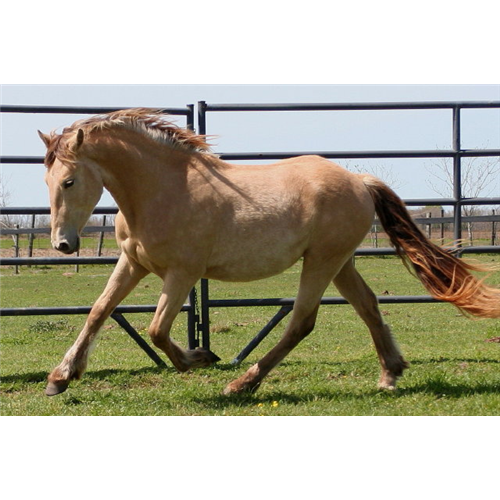
If I had the time and the money for a second horse right now, this young man would be my choice. He’s a Friesian/Andalusian cross, 20 months old and still a stallion. He’s a gorgeous color called “champagne” which actually reminds me of the American Sulphur Horses. He’s at a farm in Texas. Anyone want to take a road trip?

Imagine

Before people are actively involved in horses as a culture, when they have still only ridden once or twice or just admired horses from afar, if you ask them what draws them in about these animals, most of the answers are quite uniform : beauty, strength/grace and freedom.  The answers are so standard they border on cliche, but it doesn’t make them any less true. Horses ARE beautiful, powerful and often symbolic of freedom, as in the mustang of the west. But what has caught my attention lately, is how traditional horse culture and traditional training systems undermine or destroy the very qualities that draw humans to horses in the first place.

I am saddened to see another generation of young riders already indoctrinated into the language of the dominant horse culture, phrases such as : “he’s such an idiot!”, “you stupid cow!”, ” if he had a brain…” . These are phrases that openly name horses as stupid and they are so familiar to me from years and years of hanging around different riding schools that I don’t usually even hear them. Except now that I am training with a clicker and constantly looking for beautiful, balanced, correct responses, I find myself saying : “Aren’t you brilliant?”, “What a gorgeous horse!”, and “Beautiful!” while I train. In an arena full of people, I had a (somewhat uncomfortable) realization that I was the only one speaking this foreign language to my horse. For a moment I was self conscious, but rather immediately  that feeling shifted to shock over how mean everyone sounds when they are actively working with their horses. These are people who would profess to love their horses, who do love their horses. These are nice, normal people who don’t speak to other humans this way, you can be sure. The fact that this language is standard in the horse industry means there is a problem on a very base level in the way we are taught to  interact with these lovely animals.

I believe that when training is compulsory (the animal has no choice but to participate, or risk mental or physical punishment), it opens the door to see the animal as dangerous and “stupid”. Force/threat always increases stress, and as we know, stress inhibits learning. So, for many horses, their learning is compromised just by the presence of their “trainer” who has come to be associated with punishment. A stressed horse is a more emotional, more dangerous animal. This in turn, stresses the human, who ups the punishment/consequences. It’s a lose/lose situation and it pits people as adversaries against their horses. It is so much better to be an ally.

No horse-crazy child dreams of tying their horses head to his chest so they can control them. No horse-crazy child dreams of whacking their horse in the chin with a heavy metal snap to teach them to back up. What we initially feel about a horse is reverence.

Wive’s tale says horses are too dangerous to feed by hand, too dumb to be trusted to make their own decisions, too lazy to offer beautiful work without compulsion. Clicker training shows the opposite.

Training should open the door to an enhanced relationship, mutual appreciation and trust, and sometimes, on great days, awe/intimacy. Why shouldn’t we use a training system that teaches us how to shape and appreciate beauty and to respect but collaborate with horses’ strength and power? A training system that understands horses as intelligent, sentient creatures.

Anything less is a failure, both of relationship and imagination. We all deserve to thrive.

Longe line, cantering and emotional control

I had a fabulous training session today with Dragon, the kind of session that is addictive and leaves you feeling like the world has offered you the best of itself. Moments like this:

Dragon has always been very excitable on the longe line – he gets emotional when he is asked to move quickly, as many horses do, is very large, so sometimes becomes “tangled up” in his body, which, historically has created a fair amount of frustration for him. I would say both of us felt we would have rather avoided the canter on the longe if we had the chance. We have been working intensively on emotional control lately, shaping for physical balance, relaxed muscles, and even tempo. I have been ignoring extreme flight reactions or overstimulation, asking quietly for a transition downward. No marking wild airborne behaviors or loss of emotional control with yelling or yanking. It is the opposite of what a lot of traditional trainers recommend, mainly, immediately stopping the horse when they “misbehave” to “delete” the flight response so the behavior is not practiced. I did try this for awhile, but stopping a 1300lb horse is not  very safe for the animal’s neck and spine, since it usually takes quite a bit of force. The other problem with this is the main reason for the “misbehavior” was usually tension or fear, and a forceful, physical stop only served to up that tension and cause worse departs than before. So I tried ignoring the emotional behavior, shaping for calm, relaxed movement and took two weeks off of cantering while we built up a calm history on the longe. And today was our second day back at cantering, and he was able to offer his first immediate departs (cantering immediately on cue) and the most emotional control he has had to date in that gait. Lovely.