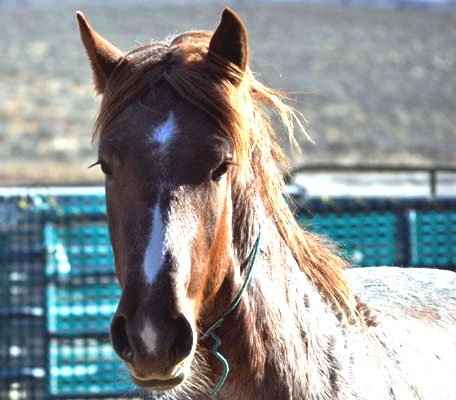
Last week Friday, Djinn, my new black mustang mare arrived from California. I had been in love with her since last October when I saw a picture of her in a BLM internet auction. She is solid black with no white markings. Something about her called to me and when I found myself still thinking of her this spring I decided to adopt her. This is the picture that I fell in love with:
When I imagined working with her, I imagined an experience similar to my other mustangs, Aesop and Tarot. Both were cautious horses who needed lots of time and incremental steps just to feel comfortable with approach and touch. I was looking forward to the exactness and subtlety of the work of taming. It’s work I really enjoy.
You can imagine my surprise when both my transporter, Rick, and the BLM contact who helped me through my adoption process called to let me know how friendly my mare was and that she approached and let both of them scratch her on the shoulder. I was a bit incredulous and double-checked with the BLM that no one works with the horses at the corrals and they assured me they do not. Regardless, Djinn is very social, actively interested in people and was obviously hand fed by someone. She was also captured as a yearling so she was much younger than my other two when she left the wild. The work I have to do with her is completely different from what I pictured. She is open, curious, tactile, beautiful and intelligent. She is exactly the horse I needed at this moment in time.
Here’s a video showing her investigating our farm cats the first day she got here:
Djinn loves touch and lets you touch/scratch over her entire body while stretching out her neck and wiggling her lips around. It would be easy to assume because she feels so tame that she will also know how to cooperate and interpret human requests. But she is completely un-educated. It is up to me to teach her the skills she will need to be an extraordinary companion. I don’t want her just to get by. I want her to thrive.
I decided I would train her every day for the first hundred days in my own version of “Extreme Mustang Makeover”. The mustang challenge or makeover is a contest where trainers receive an unhandled mustang and have 90 days to train the mustang for a competition to determine the best trained horse and win cash prizes. I’m not a fan of time limits in any training situation since the pressure often leads goal-oriented humans to make bad choices for their animal. But I am interested to see exactly how far Djinn and I get together in a hundred days. A clicker trainer’s mustang challenge. I will update weekly on her progress with video.
I quickly realized I would need to be able to ask her to move back out of my space if I was going to go into her pen. She is curious and forward and I didn’t want to end up with a 900 lb untutored horse in my lap. So after teaching her to target on days 1 and 2, I taught her how to move forward and most importantly, back, on day three. Here’s a short video of Djinn learning to move forward and back using her target:
Smart girl! On day four Djinn started to get a little grabby and over-eager about the food so I decided to teach her a default leave-it when food was in my hand or on my body. This means if I am holding food she should take her head AWAY from the food and down to the ground and wait for me to dispense it to the ground. It’s one of her first lessons in impulse control and she does a really good job.
Djinn would be an easy horse to get in trouble with if you were just learning positive reinforcement as a method. She is motivated and brave and like all new learners is more easily frustrated. It’s really important that I go to her with a training plan that addresses all the behaviors that are likely to crop up. I need to anticipate what she needs to learn so she can offer clickable behaviors and feel like learning isn’t too stressful or hard. I don’t want either of us to feel confused or unsafe.
If you are wondering what on earth a Djinn is:
A Djinn is a supernatural being that, like humans, can be good, evil or benevolent. In myth, Djinn’s can take many forms, human or animal, and are created from smokeless fire. They are fabled to be the energy behind magic tricks and the spirit that gives information to the fortune teller. Djinns or Djinnis are also the spirits who were trapped in enchanted lamps or bottles by magicians and sorcerors. If you rubbed the lamp they would appear and grant you three wishes. If one of your wishes was to set them free, they would become yours alone.
I invite you to share my journey with this playful magical spirit, Djinn.
I’ve had a few conversations lately with several different friends about the range of experiences their animals have had with animal professionals like veterinarians and hoof care specialists. Even as an animal professional myself it can feel scary to trust my horse or dog to someone else’s care who might not have the same ethics or awareness of body language that I do. Both the horse and dog world are still works in progress. Empathetic handling is not always a consideration. Behavioral health often takes a back seat to “getting the job done.” This is a particular concern when it comes to mustangs. Aesop was wild until he was four years old. He’s only known a few humans, and the first few chased him around with flags and acted unpredictably. There wasn’t time for a relationship. Unlike many domestic horses, he is not automatically trusting of new humans. It is critical that he forms a positive opinion of as many new people as possible. It is critical that he views humans as safe, since he’s known so few. It’s my job to advocate for him.
The first step in advocating for your horse (dog, bird, newt) is teaching them the skill set they will need for their procedure ahead of time. You don’t want the first time the equine podiatrist comes out to be the first time your horse has their feet picked up and held for longer periods of time. Alexandra Kurland has a saying: ” If you haven’t gone through an active teaching process to teach your animal a behavior, don’t expect to get it on a consistent basis. ” Basically, don’t leave it up to luck;) Making sure your horse is comfortable in the cross ties, can lift all four feet and hold them in different positions, is comfortable with a rasp and is comfortable with a “new” person handling him is the bare minimum for a hoof trim. Standing still and balancing on three legs are skills too, passive though they might seem.
When my new trimmer, Autumn, came out the first time I completely underestimated how afraid Aesop would be of someone new. He and I work together a lot but since we aren’t at a boarding barn there’s not many new people to get to know. Aesop was terrified of being touched by anyone at all, including me, with the new strange people in his barn. Oops! Autumn was kind enough to set up appointments with me every Monday so she could come out and handle Aesop and he could get used to her at his own pace. She’s been out three times now and he is getting really comfortable with her. It helps immensely that Autumn is relaxed and open to new ideas and has learned the “clicker game” very quickly. Here’s a (long) video of Autumn and Aesop working together today:
The video is a little bit like watching paint dry and that’s the point. If we go slowly, listen to our horses and progress only when their body language indicates comfort, the whole process of introducing new people and procedures can be relatively stress free. Once or twice in the video you will see Aesop raise his head, stiffen or just turn away toward the windows. Those are micro-expressions of stress/fear in him. When he expresses those signals, Autumn moves back to the last point in the procedure where he was comfortable. Once his muscles are soft again and his head is straight and low, we know we have the green light to move on to the next step. He even starts to offer his foot once he is sure of what we want.
It’s a new concept for animals to participate in their own care. In the past, the definition of success was “nothing happened”. But I don’t want horses who don’t move a muscle because they are terrified of the consequences. I want horses who show me through a drop of their head, offering of their foot or nice deep sigh how complicit they are in their handling. Aesop didn’t ask to be rounded up and brought into my world; it’s my responsibility to make his experience comfortable, safe and fun.
When I first re-started Dragon using the clicker all I was focused on was making sure he was relaxed and obedient. I had made some large mistakes in his early clicker training by not understanding what a good foundation was, not understanding proper food delivery and not understanding stimulus control. Once I realized I needed to cover all of those variables and went back in Dragon’s training to help him understand those concepts he became very calm, focused and rideable. I wasn’t concerned with his balance or carriage at that time. I just wanted a safe horse who would stand quietly at the mounting block, listen to the cues his rider offered and be emotionally calm under saddle. It’s a good place to start for any horse and rider, certainly. Here’s a short video of our first Why Would You Leave Me under saddle:
In the video you can see that although he is calm and relaxed, his balance leaves a lot to be desired. He is heavy on his forehand with his head nearly to his knees and his hocks strung way out behind him. On the other hand, he is doing a great job of learning to target my seatbones as a guide and staying between the channel of my legs. When he doesn’t, I slide down the rein and ask him to move back under my seatbones and click! when he stays there on his own. On the day that video was made, I was thrilled with my smart, relaxed horse. Looking at it today, I’m glad I didn’t know as much about balance as I know now. But he needed to learn about using my body for direction before we could talk more in-depth about the way he carries his body.
Over the last two years Dragon and I have moved from basic foundation exercises to more intermediate work. We’ve done a ton of ground work where he has learned to use my body as a target, tons of work on circles where he has learned to bend and take a bit more weight onto his hind end, and lots of jaw gives which allow him to go onto the bit and start to use his body more correctly. Two years sounds like a long time but learning to use your body in a completely new way and then strengthen those muscles is a process that can’t be rushed. Unlike “modern dressage” we are not doing this work on contact. That means I am asking Dragon for a certain bend or head elevation and I am asking him to hold that posture on his own. He doesn’t have reins to lean on so he has to build his own correct muscle and truly understand the process, not just passively allow himself to be molded. This way I know he is in true self-carriage. I’m learning the process as well, which makes it a touch slower. Here’s a video of our ride today where we were working on jaw gives and bend while following my seatbones:
My whole life I wanted to learn dressage. I read myriad books, took infinite lessons and still I was left not understanding the whole picture or how to influence my horse so he could learn to carry himself more athletically. It is a difficult discipline even for a supremely talented rider, and often those who do it best are unable to articulate it to others. It is only through following the work in The Click That Teaches by Alexandra Kurland that I finally am learning how to help my horse balance and how to use my own body to teach him. We are finally moving toward the dream of a centaur, not on heavy restrictive contact, but lightly, together.
This spring my partner Sara’s horse, Fig, turns seven. Fig was unstarted when Sara bought her two years ago and they’ve spent this time getting to know one another and building a solid foundation of clicker lessons. Fig is Sara’s first horse and they are taking their time. As they have progressed in their work from basic emotional control to more subtle work, Fig has become increasingly thoughtful, attentive and controlled. It feels like time to think about riding.
What does this mean? It means that Fig is able to offer learned behaviors even when the environment changes or is scary. It means Fig is much more centered and calm than she was even a year ago, able to handle maneuvering her body in tight spaces, being asked to stop even when she would rather go and finds listening to Sara reinforcing. She has both learned the behaviors necessary for a safe riding horse and demonstrated she can follow guidance offered from a human partner in a tight situation.
Here’s a video of Sara and Fig’s latest lesson:
In this video, you see that Fig is working in her bridle. Sara first picks up the rein. If Fig stays attentive and doesn’t walk off, click/treat. Once she picks up the rein, she will slide her inside hand down and ask Fig to give at the jaw, click/treat. If she can do both of these things without walking off (receive information about how to move off without rushing or emotionally running away) then Sara breathes in deeply so her side touches Fig where Sara’s leg will once she is mounted. When Fig moves off on this cue, click/treat. If she moves off before this, you will see Sara slide her hand down the inside rein and pivot to face Fig, asking her to ‘re-set’ and back-up. It’s important for Fig and any riding horse to be able to make a mistake and not be upset if she is re-set or told to look for another answer. If Fig looks to the outside of the circle, Sara slides her hand down the rein and waits for Fig to give at the jaw again, asking her to remain on the circle without constant contact as a reminder, click/treat.
While they are walking together on the circle, Fig is using Sara’s body as a target. We literally want her “in front of the leg” just like a horse would be under saddle – not lagging behind and not rushing away without regard for where Sara is in relation to her. This way, Fig already understands the concept of Sara’s body being a guide for her, as her seatbones and legs will be under saddle. So far it looks like a pretty nice ride!
But how about the mounting block? It’s important to make sure your horse understands how to stand still at the mounting block and is ok with pressure on their back and the sight of you up over their head. Here, Fig is bareback, but she shows she understands the concept of lining up to the mounting block and offering her back to Sara.
Notice that Fig is free to walk off but chooses to stay at the mounting block because of a solid reinforcement history. This allows the mounting block behavior to become a “barometer” of whether or not to get on your horse. Since it was introduced as a fun game and is something Fig enjoys, if she won’t line up or moves off we can guess she is sore, not feeling well or having a bad day. This is good information to have and information we want with all horses, but with a green horse, especially. This week Fig will practice the mounting block saddled, to get used to stirrups being pulled and weighted and the feel of a saddle shifting on her back.
So what’s left? Sara needs to confirm all her bridle cues at the trot and practice all her work saddled with stirrups flapping. Alexandra has a saying, “When your horse is ready, he will invite you onto his back.” I love that saying because I see so much early work that is more like, “If you think you can get away with it with only minor injury, do it.” Riding should be a partnership from the very start and it’s our responsibility to provide the good foundation. I think Sara has done a great job!
Since I adopted Glasswing in April of 2009, we have had a hard time bonding. She is a crabby little mare in general and even though she does learn most lessons I set out to teach, she always has her ears back and is impatient or frustrated. Sometimes she gets so excited about the food reward she moves into sexual arousal and treats me like a stallion, squealing and presenting to me. I admit I haven’t invested the same amount of time working with her as I have with my other horses because of her unhappiness and arousal during lessons. It is difficult to look forward to working on her emotional issues constantly instead of a satisfying progression toward riding. She treats the other horses much worse than she treats me – constantly laying back her ears if they come anywhere near her space, biting and going after horses much larger than herself and actively running after and biting the divider between the two sides of our lean-to at feeding time. She crosses the line from posturing to aggression. Twice she has gone after and shaken a barn cat for walking too near her hay pile.
She is a beautiful pony, though, and so smart it makes my head spin. She remembers everything I’ve taught her after one or two repetitions, much quicker than my other horses. And sometimes, in the morning while I’m scraping out the lean-to she’ll come over to greet and see what’s in my wheelbarrow and we will have a quiet, easy interaction.
When I first saw her picture she reminded me of a witch’s pony – dark chocolate with snowcap overlaid and a pattern of mottled brown on her neck that reminds me of a map of a foreign place. A silver mane and eyes that look human. An odd looking pony, but powerful too.
For over a year I have had a beautiful bridle picked out for her, a tiny dark-oiled western bridle set with stones. I was going to purchase it as a reward for myself once I had finished all her groundwork but she’s just not at the place where she wants to be ridden. The riding will come when her emotions level out. The accomplishment with Glasswing will not be riding (I’ve already sat on her back multiple times), but helping her relax and enjoy work without being over-aroused and over-intense.
Our lessons for this winter will be working on “Happy Ears”, a foundation lesson from Alexandra Kurland, at least three days a week. I’ve selected a low-value food to decrease as much arousal/stress as possible. Basically, we will go for walks both indoors and out and every time she puts her ears forward she will receive a click and treat. Since ears forward is physiologically linked to a different emotional state than she typically displays when working, I am looking to condition a new state of mind during training. As she is successful I will look for her to keep her ears forward for longer and longer duration. Hopefully, by spring, she will be ready to re-visit some of her other lessons in a new state of mind. I invite you to come along on this journey with me and my crabby, strange, gorgeous pony who sees the world in a way I’m still trying to figure out. 2012 is supposed to be a year of transformation – so let us begin!
Here’s Aesop’s second lesson in lifting his feet. He’s getting the hang of the front feet. One or two more times and he should have back feet down just as well. I want to document each step so people have a realistic idea of what it looks like to work through this skill set using positive reinforcement. As far as the back feet, I’m clicking for him lifting them early in the action so that he is reinforced when he just starts to lift the foot, not when the leg is at it’s highest point. This should help him lift it slower and in a more relaxed fashion. When the lift is more relaxed I will start to hold the fetlock hair through the lift like I did initially with the front feet. Eventually we will work through to picking his hoofs, then rasping them in preparation for the farrier.
Here’s a short video of Aesop’s first hoof handling. This is also his first time in the barn. As you can see from his behavior in the video, he is pretty much a “low conflict” animal. He is not one to worry too much or expend a lot of extra energy.
Since we are using positive reinforcement, if he pulls away I just let his foot go. I don’t want him to feel trapped or elicit or build an opposition reflex. We just try again and when he is able to accept the hold and lift his foot without pulling he gets a click and a release. I know it isn’t a very dramatic video, but this is truly his FIRST hoof care lesson.
Aesop has definitely turned into a “clicker-horse” this last week and sees people more as an opportunity for reinforcement than as scary, foreign beings. He follows along the fence-line now when he sees us walking by and eagerly plays his target game inside of his round pen.
I have moved on to face touches with him so we can move toward haltering, grooming and leading in the near future. I used the targeting to get him close. Once he was calm and really comfortable standing within reach of me, I just reached up to his nose. If he backed away, I walked off a few feet and let him approach me to begin again. When he didn’t back away, I clicked and treated. Here, in our second session, you see that he is starting to understand what to expect and begins to “offer” me his nose with a slight bend toward me. At :54 you will see him be unable to stay through the touch and pull his nose off to the right. I just let him go and immediately he offers his head to try again and is successful. What a good boy! Again, no coercion. If he wants to walk off and not work on being a tame horse today, he can. If he is particularly relaxed and loose during a face touch, I reward him with a chance to target.
The face offering is a wonderful example of two way communication with a horse. I chose the lesson and the rough framework for it, but Aesop added in a bit of bend when he felt relaxed and ready. He could do this because I was predictable and the rules of the game were consistent. If I am aware and present in my work with my horses, I will begin to notice body language and micro-expressions that will inform the work I do. As I notice these small offerings and honor them, Aesop will become even more relaxed with me and be able to trust even more.
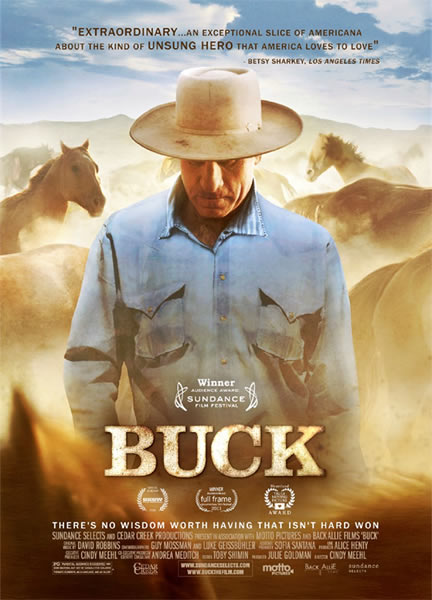
Last night I went to see “Buck”, the documentary about Buck Brannaman, a natural horsemanship trainer who travels the United States teaching people how to ‘gentle’ their horses, start their colts and generally understand more ‘about why horses do what they do.’
Where do I begin?
I know that what used to pass for horse training was nothing more than non-contingent punishment and flooding until the horse gave up resisting out of pure exhaustion. If you were watching a video of that it would look like this:
Let’s be honest: that’s not even training. It’s just humans jumping on, holding on with our opposable thumbs and long bi-pedal legs and sheer tenacity until the equine decided it took way too much energy to try to get rid of these tall, unpredictable animals who wanted to cling to their backs. There is no regard for the animal, just a display of power for the human and some machismo to be gained. It did achieve behavior change, but at great stress and cost to both the horse and the human, sometimes even their lives. For the ones that made it through the training alive and uninjured, their first association with someone on their back was poisoned as an emotionally and physically grueling, if not scarring event.
The “training” I saw in ‘Buck’ was just a step above. He does have a picture of the behavior he wants the horse to offer and FAR better timing than the old “horse breakers”, but he does shape most of his behaviors using quick jerks on a rope halter or by waving long flags to move the horses off. The horse’s motivation is definitely avoidance. He talks about horses being afraid for their lives and understanding how that feels, but when a buckskin mare he has on a very short lead crashes through him with her shoulder desperately trying to get away from his flag, her head gets jerked around so fast her hind end spins out. In my book, that’s not sympathy to her fear. It’s punishing the shoulder crowding even though the horse is already overfaced. Maybe she’s had enough for the day. Maybe she needs her training chunked down into smaller lessons. Buck is a lumper, not a splitter. A ‘lumper’ is a trainer who presents training to their animals in big chunks which makes it harder for the animal to understand. They don’t break the behavior into all of it’s component parts so the animal gets a lot of “wrong” answers and the training is very stressful.
There is no reason that a young horse has to go from being untouched to ridden in the same day.
Buck Brannaman stressed, scared, and intimidated most of the horses he worked with. He is a survivor of abuse himself and he probably does believe he is giving horses ‘a better deal” but I think it’s a good thing horses can’t talk. Over and over I saw people at his clinics amazed by how effectively he could flood a horse by restricting it’s movement and causing it to be “calm” because it learned struggling was painful and fruitless. It’s impressive to watch a horse go from bucking, twisting and kicking out to moving forward calmly. But a good trainer never causes the horse to buck or kick out in the first place. Just because you can rope a horse by the leg and safely immobilize him from a distance doesn’t mean you should. It looks good on film, but if you measured the cortisol level in those horses’ bloodstreams, you’d likely find it’s the same as Buck’s on the nights his father came after him and his brother Smokie in anger.
There is a 3 year old stallion in the movie, a very confused and dangerous bottle-fed orphan, who shows up at one of Buck’s clinics. Bottle-fed horses often grow up to be aggressive. Without the species-appropriate influence of their mother to teach them about dealing with frustration, inhibiting their teeth/hooves and lack of outlet for appropriate horse play, they grow up to be both very physical and to have a short fuse. It’s a bad combination in a 1000 lb animal. A thoughtful plan for dealing with this horse would have been to call the vet, have him sedated and gelded right there in one of the clinic pens and given him 3 more months for the testosterone to drain out of his system before assessing whether or not it was even safe to work with him. Give the woman her money back in order to pay for the surgery and meet her somewhere else on the road if it seemed viable. Instead, Buck decided to work with the horse. First, he roped the stallion’s back left fetlock (a move that could have caused serious joint injury) and pulled him to a halt from his own horse. He kept the horse busy enough with the pressure on and off his leg for another man to get the horse haltered, saddled and ridden. It was an incredibly tense and chaotic scene. The flooding did not work on the stallion and he did not come out of the pen quiet or subdued. He WAS tired and limping. Later on, when the same man goes back alone to lead the stallion and ‘sack him out’ with some saddle blankets the horse becomes increasingly aroused and ends up snaking his neck out and biting the man in the forehead before he knocks him to the ground and attempts to kneel on him in an effort to kill him. The man lives, but he easily could have been killed. The owner decides she needs to put the horse down for everyone’s safety, and eventually, he is loaded onto the trailer without anyone else getting hurt, but not before the stallion gets one more bite attempt in toward the injured man’s head.
The next day, when the clinic participants ask Buck to speak about the colt, he talks a lot about the responsibility of raising a youngster and that the colt might have been fine if he would have had the right upbringing. But he isn’t clear about which behavior issues are caused by the bottle feeding, or what the stallion’s owner could have done differently, or the fact that gelding him 2 years ago might have helped. I am fanatical about clear language. Telling people it is a big responsibility to bring up a youngster does not give them any tools for navigating the situation more successfully themselves in the future. We have a huge problem in animal training with experienced, intuitive trainers who have not taken the time to learn how to teach verbally the specifics of what they know how to do experientially. If you don’t take the time to learn the science and terminology behind what you are actually doing moment to moment, the knowledge ends with you. You have to be able to explain it in order to transfer the knowledge to other people. Otherwise, clinics are nothing more than a traveling show. People might be amazed, but not changed. For the welfare of horses to improve, people need to learn why and how, so they can replicate it with their own animals.
People are easily dazzled, especially when they haven’t yet learned enough to see the real tools being employed in training. We aren’t taught much learning theory or ethology in school, so it’s hard to know what we’re looking at. Maybe it’s voodoo that the horse is following Buck around ‘like a puppy’ after five minutes in a round pen or maybe it’s that every time the horse turned away it got ‘sent off’ at a good trot or canter and it quickly learned following Buck was the only way to conserve energy, a necessary resource for an animal that gets eaten when it can’t run anymore. And for the record, that is negative reinforcement, adding in something uncomfortable or fear inducing that the animal can avoid if it offers the right behavior. There is a choice involved, although its a bit of a rock and a hard place. Be exhausted and afraid, or follow me around. That’s coercion.
It is good that humanity at large is realizing that horses deserve better treatment. The natural horsemanship phenomenon was the first step in moving toward a more humane life for horses. But these men like Buck that are being hailed as magicians and sages are no longer the leading edge of what is happening in the horse training world. We have new technology that allows us to teach horses what we want from them without ever even eliciting high level stress or the flight response. We have science that explains how horses learn so we don’t have to rely on mythology or fairytales anymore. We have empathy that we can extend even further from denouncing punishment and abuse to understanding that riding on a horse’s back is our dream, not theirs. We owe it to them to teach it in such a way that they actively enjoy and collaborate in the process. No ropes. No bucking. No intimidation, flooding or learned helplessness masquerading as calm acceptance.
Positive reinforcement is the new frontier. The horse decides what is reinforcing (carrots, apples, peppermints) and the responsibility is on trainer to make the lesson interesting and worthwhile and safe for the horse. There is a quote by Henry Beston I have loved since I was a child:
For the animal shall not be measured by man. In a world older and more complete than ours, they move finished and complete, gifted with the extension of the senses we have lost or never attained, living by voices we shall never hear. They are not brethren, they are not underlings: they are other nations, caught with ourselves in the net of life and time, fellow prisoners of the splendour and travail of the earth.
We can’t assume to know the exact shape of a horse’s world. But we can teach them in a way that honors our difference. We can approach them as equals and invite them to learn what we have to teach. People talk a lot about horses learning respect but maybe we should look at our end of the lead rope. Your horse is your mirror.
About twelve days ago, Sara and I set off with three of our dogs, a jeep and a horse trailer to pick up our new horse from the BLM adoption center in Oklahoma. Whether or not I agree with the round-up of wild horses ( I don’t) is secondary to the reality that there are roughly 50,000 captive and wanting for good homes. We “won” Aesop on one of the BLM online auctions in May after a fierce bidding competition with someone from New York. We fell in love with his soft eye, balanced conformation and gorgeous strawberry roan color.
Aesop Rye in Oregon
It was a good twenty hour drive both ways to pick him up, and by the time we got him home to Idle Moon Farm all of us were exhausted. He rode in the trailer like a champ, though, and we managed to drive without causing him too much stress, I hope. And he had regular stop breaks so he could rest his muscles from active balancing.
The very first day I had to approach his corral to give him hay so I began immediately with advance and retreat. For those of you who aren’t familiar with wild horse training, advance and retreat utilizes distance or retreat as reward for horses who aren’t yet tame. You can use it on birds, goats and llamas too. The general rule is you move just enough toward the horse to cause some concern, but not enough to make them walk or trot off. You then wait in that space until they turn their face toward you, ideally two ears and eyes focused on you and then you reward them immediately for showing interest by walking away. In that way you can close the distance between you and the horse and de-sensitize them to proximity to humans. Otherwise known as: they get used to you being closer to them. I practiced advance and retreat the first couple of days, and Aesop even came over and touched my arm once or twice – great!
At first, advance and retreat felt great and I did get much closer to Aesop. But after two or three successful sessions where I got within a few feet or even had him touching my arm or following me for a few steps, I started to feel uneasy. Even though he offered the behavior I wanted, he didn’t seem engaged and his posture began to look defeated. A few times he turned his butt toward me, not quickly, to kick, but to tune me out and pretend I wasn’t there. Depressing. I could swear I heard him sigh as I entered the pasture.
A core component of my ethics when working with animals is that they deserve choice in their lives. I don’t believe horses or dogs or birds are here to comply with my wishes or that humans have any sort of dominion over the beasts of the earth. I do believe if I am intelligent, sensitive and thoughtful enough I can convince most animals that playing the training games I have to offer is worth their time. But the responsibility is on me to convince them. Without coercion. Because advance and retreat utilizes discomfort as a motivator, it really is negative reinforcement. I was putting just enough pressure on Aesop to make him mildly nervous and he could get rid of the pressure by turning to look at me. Yes he could leave and walk away from the session. But I was the one who got to decide when to start and end the game. There just wasn’t much choice for Aesop.
With a tame horse who I have been training for years, who knows me and lives in relationship to me, constraining choice might not be very alarming for them. They know I am safe and provide solid information to help them through new training situations. But this horse and I were new to each other and it wasn’t how I wanted to begin our relationship. Luckily , Aesop was willing to take handfuls of grass through the fence from a human’s outstretched arm. That meant I was able to deliver food to him, which meant I could start clicker training. I started with Alexandra Kurland’s/Kay Laurence’s concept of micro-shaping and clicked any lean or movement toward me, then fed. Very quickly he was following me around the perimeter of the pen and much more comfortable with me moving my body and arms as it was required for feeding. Once I had him following me, I began to leave my open palm sideways on the fence, right in the way of his nose. At first he was nervous of my hand being out, but his curiosity got the better of him and he bumped my hand. Click! Our first hand target.
After a day or two of targeting outside the fence, I thought Aesop understood the structure of the game well enough that the behavior would hold up if I entered the pen. I unlatched the gate and he had barely any lag time before he reached out to touch my hand. Inside the pen, I clicked Aesop for moving toward me, even before he touched my hand, because it was more important for him to feel confident approaching me than to touch me right away. I was infinitely more comfortable using targeting because you can see Aesop’s enthusiasm and enjoyment of the game. The method is more sophisticated than it first appears because while my horse is enjoying eating his treats and reaching out for my hand, he is also getting used to my hands reaching out toward his face, reaching back into my treat pouch and back out to his face. These are motions that I need him to be comfortable with for haltering and grooming. Here’s a video of that whole session, beginning outside the pen and ending inside:
I love how comfortable and relaxed his posture is. I love the loose way he moves forward showing his lack of tension. I love his continuation with the game once I enter his space, which a worried horse would not be able to do. There is so much information to be had out of this simple act of targeting if you only know what to look for.

 When I imagined working with her, I imagined an experience similar to my other mustangs, Aesop and Tarot. Both were cautious horses who needed lots of time and incremental steps just to feel comfortable with approach and touch. I was looking forward to the exactness and subtlety of the work of taming. It’s work I really enjoy.
 Spellbound