A new mustang: advance and retreat or the clicker?

About twelve days ago, Sara and I set off with three of our dogs, a jeep and a horse trailer to pick up our new horse from the BLM adoption center in Oklahoma. Whether or not I agree with the round-up of wild horses ( I don’t)  is secondary to the reality that there are roughly 50,000 captive and wanting for good homes. We “won” Aesop on one of the BLM online auctions in May after a fierce bidding competition with someone from New York. We fell in love with his soft eye, balanced conformation and gorgeous strawberry roan color.
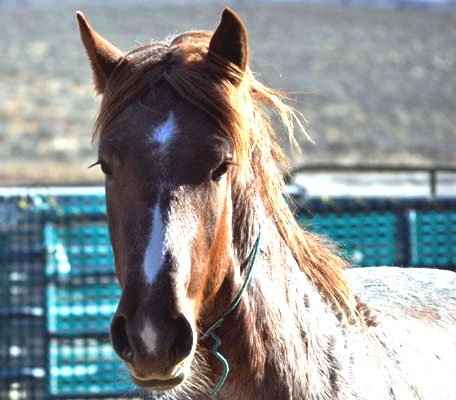
Aesop Rye in Oregon

It was a good twenty hour drive both ways to pick him up, and by the time we got him home to Idle Moon Farm all of us were exhausted. He rode in the trailer like a champ, though, and we managed to drive without causing him too much stress, I hope. And he had regular stop breaks so he could rest his muscles from  active balancing.

The very first day I had to approach his corral to give him hay so I began immediately with advance and retreat. For those of you who aren’t familiar with wild horse training, advance and retreat utilizes distance or retreat as reward for horses who aren’t yet tame. You can use it on birds, goats and llamas too. The general rule is you move just enough toward the horse to cause some concern, but not enough to make them walk or trot off. You then wait in that space until they turn their face toward you, ideally two ears and eyes focused on you and then you reward them immediately for showing interest by walking away. In that way you can close the distance between you and the horse and de-sensitize them to proximity to humans. Otherwise known as:  they get used to you being closer to them.  I practiced advance and retreat the first couple of days, and  Aesop even came over and touched my arm once or twice – great!

At first, advance and retreat felt great and I did get much closer to Aesop. But after two or three successful sessions where I got within a few feet or even had him touching my arm or following me for a few steps, I started to feel uneasy. Even though he offered the behavior I wanted, he didn’t seem engaged and his posture began to look defeated. A few times he turned his butt toward me, not quickly, to kick, but to tune me out and pretend I wasn’t there. Depressing. I could swear I heard him sigh as I entered the pasture.

A core component of my ethics when working with animals is that they deserve choice in their lives. I don’t believe horses or dogs or birds are here to comply with my wishes or that humans have any sort of dominion over the beasts of the earth. I do believe if I am intelligent, sensitive and thoughtful enough I can convince most animals that playing the training games I have to offer is worth their time. But the responsibility is on me to convince them. Without coercion. Because advance and retreat utilizes  discomfort as a motivator, it really is negative reinforcement. I was putting just enough pressure on Aesop to make him mildly nervous and he could get rid of the pressure by turning to look at me. Yes he could leave and walk away from the session. But I was the one who got to decide when to start and end the game. There just wasn’t much choice for  Aesop.

With a tame horse who I have been training for years, who knows me and lives in relationship to me, constraining choice might not be very alarming for them. They know I am safe and provide solid information to help them through new training situations. But this horse and I were new to each other and it wasn’t how I wanted to begin our relationship.  Luckily , Aesop was willing to take handfuls of grass through the fence from a human’s outstretched arm. That meant I was able to deliver food to him, which meant I could start clicker training. I started with Alexandra Kurland’s/Kay Laurence’s concept of micro-shaping and clicked any lean or movement toward me, then fed. Very quickly he was following me around the perimeter of the pen and much more comfortable with me moving my body and arms as it was required for feeding. Once I had him following me, I began to leave my open palm sideways on the fence, right in the way of his nose. At first he was nervous of my hand being out, but his curiosity got the better of him and he bumped my hand. Click!  Our first hand target.

After a day or two of targeting outside the fence, I thought Aesop understood the structure of the game well enough that the behavior would hold up if I entered the pen. I unlatched the gate and he had barely any lag time before he reached out to touch my hand. Inside the pen, I clicked Aesop for moving toward me, even before he touched my hand, because it was more important for him to feel confident approaching me than to touch me right away. I was infinitely more comfortable using targeting because you can see Aesop’s enthusiasm and enjoyment of the game.  The method is more sophisticated than it first appears because while my horse is enjoying eating his treats and reaching out for my hand, he is also getting used to my hands reaching out toward his face, reaching back into my treat pouch and back out to his face. These are motions that I need him to be comfortable with for haltering and grooming. Here’s a video of that whole session, beginning outside the pen and ending inside:

I love how comfortable and relaxed his posture is. I love  the loose way he moves forward showing his lack of tension. I love his continuation with the game once I enter his space, which a worried horse would not be able to do. There is so much information to be had out of this simple act of targeting if you only know what to look for.
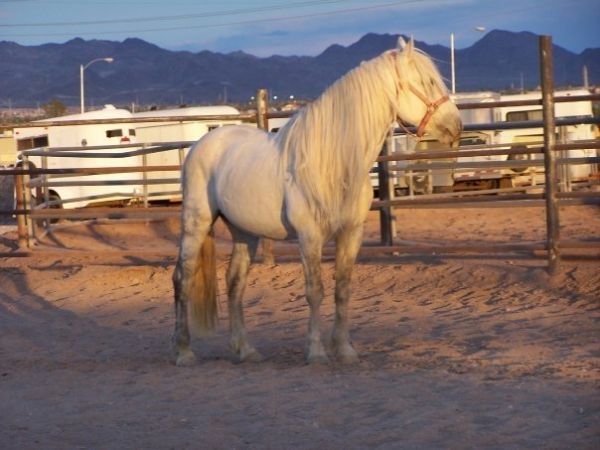
Dragon under saddle

Since Dragon and I started back under saddle this spring, we have been working further on single rein riding. Single rein riding, as opposed to riding on two reins/contact, helps the horse learn to maintain the position you suggest for them on their own. This is called “self-carriage” – a term most dressage riders are familiar with but perhaps not totally confident about. It certainly is difficult to know if your horse is in true self-carriage if you constantly ride on two reins basically holding your horse in position. And it’s harder for your horse to understand as well.  Single rein riding is new to me, so I am still learning with Dragon. Surprisingly, our rides are still significantly better then they ever were when we were riding on contact.

We both have a lot to learn but the process is a lot of fun and we’re both enjoying ourselves.  Below is a short clip of Dragon learning to mobilize his shoulders. Being able to move your shoulders is an important component for upper level work because it’s necessary for lateral work. And lateral work is necessary to teach the horse collection.  I’m still working on perfecting my rein mechanics, but it’s still a nice clip of a fairly organized moment between us.

Loose horse!

This morning I woke up and looked out my bedroom window, like I do every morning, to find part of Tarot’s fence down. He had managed to take down part of the bottom line completely and to push the second line out of place. I scanned quickly for him but I knew he was gone. The fresh spring grass is just starting to come up and last year he moved a round pen about 4 feet just with the continuous pressure of his neck as he reached for one blade of grass and then another. Kind of like the heaviest grazing muzzle on earth.

Through the window I couldn’t see him anywhere on the property. He’s an easy horse to see , being white, against a currently brown and green-ish landscape. My heart was pounding as I pictured him galloping over roads in our town and large men trying to capture him with ropes, then shouting at me, “Is that your horse, girl? You better catch him!”  It sounds dramatic, but I know how wild humans act around loose animals. Like all the world has lost it’s order.

I pulled on my boots, my treat pouch and walked outside as fast as I could without running. All three of our other horses were looking off  with raised heads into a farmer’s field behind our barn, so I knew if Tarot wasn’t still there, he had gone that way. I grabbed a halter and lead  and headed out. Our property is lined with tall pine trees that obscure most of the view of neighboring land and break the wind in winter, so I didn’t know what I would find. When I came through the trees, Tarot was about 400 feet away, presumably munching on dead wheat.  I walked toward him in a roundabout way and halfway to him he decided to close the distance for me. He started walking toward me, so I turned and started heading back toward the barn too. I’ll admit, I was nervous if I tried to “catch” him,  he would think better of it and take off. I have worked a lot on haltering, but not loose in endless farmland. We walked back through the treeline to our farm. I clicked him and he stopped for his treat, calmly, just like we were training in his paddock. I asked him to target and he targeted, but too gently, which usually means his environment is overfacing him a bit. He stayed for his treat, then walked about 15 feet away to nicker to our mares who were at the fence.

I thought about going to get a feed tub of oats or strategy, but I decided to use our skills. I walked over to him and presented his halter. He put his nose in immediately and calmly and kept his head low even while I buckled the crown. For some people, haltering a horse who you have actively taught to self-halter would mean nothing more than the animal doing what it’s learned. Good training is one way to describe what happened. But good training gives way to deeper meaning. It’s the  reason I pursue any training, of any species. For me, Tarot putting his nose in his halter, is the glimmering edge of salvation.  [Salvation(n) : the act of saving or protecting from harm, risk, loss, destruction.]  My soul is protected from harm, risk, loss and destruction when a wild horse chooses his halter, his tether to to me, over open fields and two flirting mares. When he can say:  I trust you, I choose you , then I am saved. From what? From ignorance. From entitlement. From failure to imagine his reality. From the loneliness of being isolated in my own species.

My horse put his nose in a halter, loose, on the edge of open fields. He was born wild. There is no money I could make today that could rival, from him, his yes.

How many steps, exactly, go into haltering a horse?

I have been spending some time refining Tarot’s self-haltering behavior, making sure I didn’t skip any steps and “lump” any of the behavior. Lumping is when you try to teach behavior in too big of chunks and end up skipping steps, so the animal is confused and the behavior isn’t as solid as it could be. A “shaky tower” of sorts.  I had noticed that even though Tarot was putting his face willingly into the halter and holding it there while I threw the crown strap over, sometimes his head was coming up a bit when I reached my hand from the right to the left and sometimes when I put my hand to the buckle to secure it into place.  So I went back to the place where the behavior was perfect and made sure I had all my steps in place.  I had to start back at bringing my right hand down:

Once he could keep his head down with my arm dropping down, it was time to move it up to touch the buckle. Here’s that step:

So, our next step is the buckle, re-visited, with a low, still head. I was laughing at myself, thinking about how in traditional horse training I would likely be viewed as crazy. Who cares if the horse raises his head 3 inches when you latch the buckle? There’s bigger and better things to get onto, like riding! And, I agree, riding will be great, but not until we both think so. If I skip just this tiny step of making sure Tarot is comfortable with his halter, then I am ignoring his comfort level with equipment on his body. I don’t want to do that because his comfort is my safety, among other things.

The dream of a common language

Today our new barefoot trimmer, I’ll call him Bob, came to trim hooves and meet our horses for the first time. It’s always nerve- wracking for me, mainly because there is no common language with which to discuss horse behavior and training. It is a delicate dance to meet someone for the first time, respect their learning and experience while also setting out boundaries for how you want your own animals to be treated.

I was particularly worried about this in the case of Tarot, who is untrusting of anyone new. I had already planned to have him sedated for his first few farrier appointments so that he can enjoy the anti-anxiety properties of the sedatives, and not become even less trusting of people than he already is. He does let me near his body, and allows me to handle his legs, but it’s a skill he will need to learn to transfer to someone new. It takes time, whatever time he decides, not the minutes or hours that humans tend to offer. Last night at dinner, I was dreaming about a trimmer who I could call up and say, “I have a mustang who I’m still working on body handling with. We work at liberty so I know he is truly relaxed and choosing to be a part of this handling. I can work around his entire left side and handle down to his fetlocks, but I’m still working on handling past his withers on his right side. Since he is still not completely ready for handling by me, I’m choosing sedation initially to reduce anxiety and avoid losing ground on the training we’ve already accomplished.”  Simple, right?

It would be simple if the real issue in the horse world was only that we use different jargon to explain the same techniques. But the real issue is that misconceptions about horse behavior abound and the science of learning is not common knowledge. I am a bridge-builder and a peacemaker by nature but I am also unalterably firm about protecting my animals from un-needed stress or bad handling. So how to navigate the line between making people feel comfortable and valued while advocating for my horse who does not deserve one more confusing or fear-inducing interaction with any human?

I made a deal with myself: I would let the trimmer go in the pasture and meet Tarot with Tarot loose. If he could get Tarot to stand quietly and accept his being near, I would halter him. Now, I didn’t expect Tarot to stand there at all, but I thought it would at least give Bob a chance to meet him and make a judgement call on his own.

I should mention Bob ended up doing a great job with our other horses. He was relaxed, easy-going and comfortable with all of them. He did a lovely job trimming their feet, no one was stressed and I was really happy with the entire process. He is a patient man, comfortable in his skin with clean clear energy. I was not worried about letting him meet Tarot.

I offered Bob a few treats to take in to Tarot, but  he only wanted to use his body and space, ” just like another horse would.” I pointed out that it was likely Tarot didn’t think he was a horse, especially with the walking on two legs. He laughed but I couldn’t convince him to use the food. Tarot did reach his nose out to sniff his hand, I gesture I promptly clicked and treated, but nothing beyond that cursory investigation. Tarot was careful to stay frontal to Bob and to put his body behind mine when possible. No surprise. Bob then asked if I would halter him up so he could move him around a little and see what he could do.  I explained to Bob that I had just re-trained the halter behavior and it would be a betrayal for me to take this behavior I had built, then use it to hand Tarot over into a situation where he felt unsafe and fearful. He looked honestly surprised but then quickly recovered and said, “Ok, that sounds reasonable, we’ll just find a time where we can get the vet out and use the sedative then.”  Lots of points in my book!

Bob IS unusual in how relaxed and easy he is with horses, but he is not unusual in the belief system he has about training. The common wisdom of Pat Parelli which seems to have saturated the entire horse world, that the only way to communicate with horses is through taking up their space and rewarding them through rest, “just like another horse” has become a near religion. Of course it’s good training to use modes of communication that are ethologically appropriate for the species you are teaching, but it’s not the same as them actually believing you are of a different species. That takes it too far.  Tarot, who grew up wild, has no illusions about any human being a horse, no matter how savvy.  These systems people use are made up negative reinforcement,  positive punishment, and poisoned cues. But none of the horse whisperers are teaching the science, they’re only selling the magic. It’s a disservice and a cause for much misunderstanding. Learning can feel like magic – but if you are going to wield a spell you better understand it’s scope AND it’s limitation.

As for Tarot, he’ll be re-introduced to hoof care with the benefit of some sedation. Of course we are constantly working toward him accepting handling and new things, but I promised him I would honor his body language and his emotions, and through that, his soul. It’s the only road to trust.

Day seven: buckle day

Today was day seven of mine and Tarot’s self haltering training. Today we achieved buckling the halter – success! Tarot has the rough components of self haltering now.  I realized I still need work on smoothly and uniformly tossing the crown piece over his head to make the process less tedious. I had originally made the noseband as large as possible to make it an easy target, so that needs to be made smaller as well. And I want to capture a bit better “freeze” once the crown piece is over his head.

But, we have a new, lovely behavior and get to move forward into some foundation lessons while refining this one.

Tarot self-haltering day six

Today was day six of teaching Tarot to self-halter. He has a solid push through the nose loop, some duration on being in the loop and allowed me to flip the crown strap over his poll without throwing his head up, or panicking. Previously, just a flip of the strap in any direction would cause him to spin and leap away. Tomorrow is buckle day!

Tarot : the beginning

I think the oldest dream I can remember is of taming something wild. Gaining the trust of an animal who had been unable to trust others. Bucephalus. The Black Stallion. Flicka. So when I saw an ad for a mustang stallion who: “Needs a lot of work. Needs work with picking up back feet. Beautiful fairytale looks! Gets along with other horses no problem! No “true” interest in mares – would rather eat =D”, I was intrigued. I did not need another horse at the time and was not looking to buy any animal at all. But this mature grey stallion was so gorgeous I had to know more. Here’s the pic that stopped me cold:

Tarot

At the price he was listed for, I thought he either had to have hurt someone badly or was unrideable due to an injury. I called the owner and she explained to me that he kicked when you tried to pick his back feet, was terrified of saddles, and had recently started bolting on lead when practicing his groundwork. By all accounts he sounded like a mustang with an extremely strong “preservation instinct”  – which really boils down to extreme sensitivity to their body being touched/handled and a huge flight distance. No aggression, just caution and complete lack of trust. He sounded like a horse made for the clicker, and when she told me that the way to his heart was through food, I made up my mind to buy him.

Tarot got here mid-November and he didn’t move on to Idle Moon Farm until December. He was exactly as his previous owner said. Calm and careful. Suspicious of any man-made objects. Extremely careful about his body orientation to you – he prefers to face you so he can see what’s coming and there can be no surprises. But he loves food. And now he also loves the clicker. Please watch our journey together and enjoy.

Alexandra Kurland

Last month Alexandra Kurland came to our barn and gave a three day “advanced clicker clinic” for us and our horses. The wealth of knowledge she presented and her humbleness despite being brilliant at taking apart (splitting) traditional horse training and re-packaging it in new, clicker centered exercises made it easily the best clinic I have ever attended. It is an unusual skill to be able to look at something ancient with new eyes, while still respecting the inherently valuable pieces.  I am thinking of how old the art of horsemanship is, so old that they way horses are used and trained can feel fixed and immutable. To be able to look at that with new eyes, to split it apart into it’s component pieces using new technology and a modern respect for horses as sentient beings, is nothing short of genius. And a life’s work. I am grateful to have the chance to learn from such a talented trainer. To schedule a clinic with her or buy her books and videos, go to:  www.theclickercenter.com